Introduction: Why Structured Clarity Matters in the Age of AI
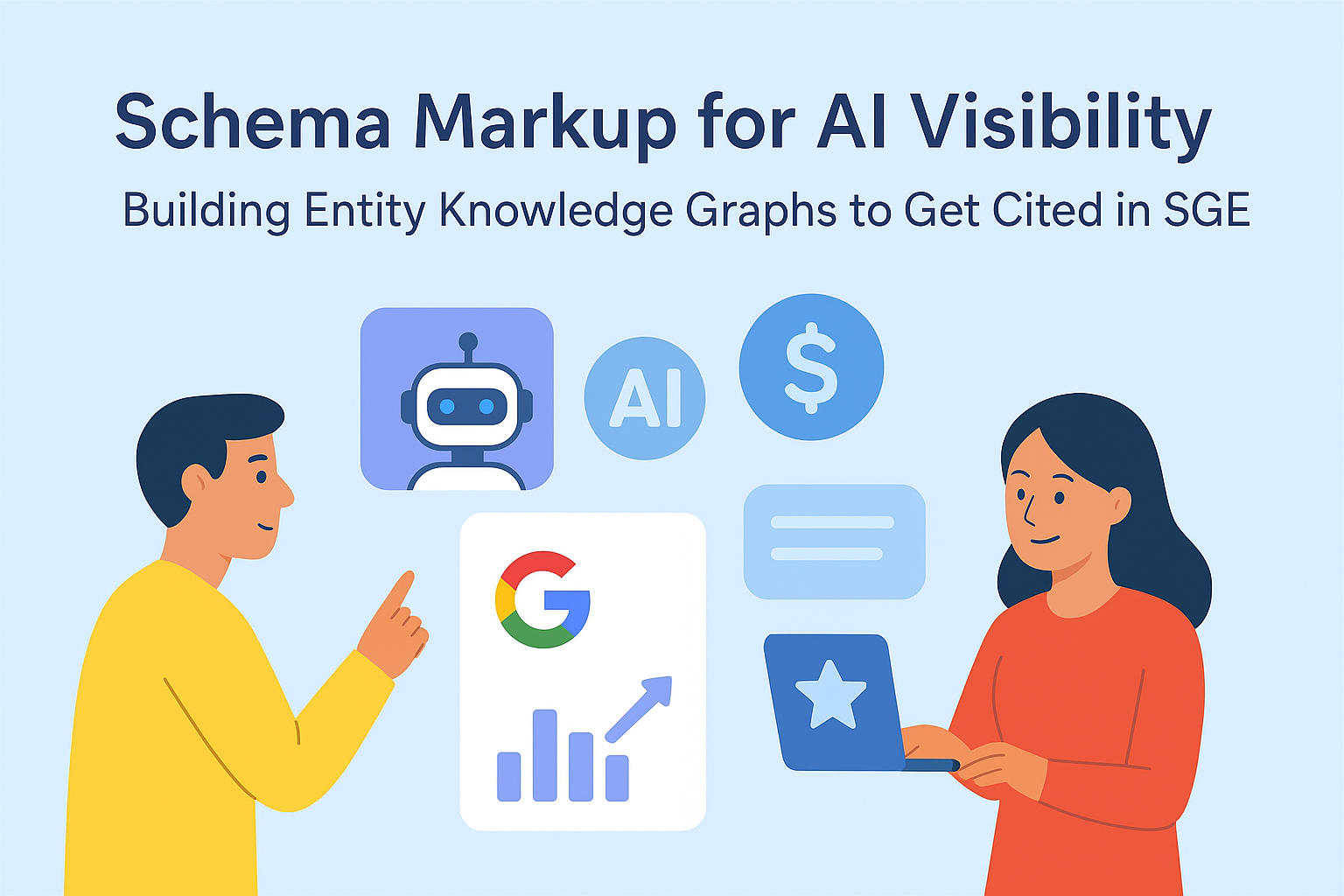
As Google’s Search Generative Experience (SGE) becomes the new norm, visibility is no longer about ranking alone, it’s about being recognised by AI systems as an authoritative source.
We understand how puzzling this can feel for marketers and business owners. You might already be creating great content, yet your brand still doesn’t appear in AI summaries or generative search results. The problem isn’t your content, it’s that AI doesn’t fully understand it.
That’s where schema markup comes in. It’s the language that helps AI make sense of your content, connect it to real-world entities and decide when your brand deserves to be cited in an AI overview.
In this guide, we’ll explain how schema markup and entity knowledge graphs work together to help your content stand out not just to humans, but to the intelligent systems shaping the future of search.
What Is Schema Markup (and Why It Matters Now)?
Schema markup is a form of structured data with small snippets of code that describe your website’s content in a language AI understands.
To a reader, your webpage might simply be a blog post about local marketing. But to an AI model, it’s a block of unstructured text unless schema tells it:
- who wrote it,
- what topic it covers,
- what business it represents and
- how it connects to other verified sources.
In essence, schema markup gives AI context. It transforms plain content into data that can be analysed, cross-referenced and trusted.
With SGE and other AI search platforms now generating summaries instead of simple lists, this clarity is critical. If Google can clearly identify your business, author and topic through structured data, you’re far more likely to be included or even cited in generative results.
From Schema to Entity: How AI Understands the Web
Search engines are moving away from keyword-based indexing towards entity-based understanding. An entity is a distinct concept like a brand, a person, a location, or a product that AI can recognise and relate to other entities.
For example, “Leadtap” might be recognised as an entity associated with:
- “digital marketing”,
- “AI content strategy” and
- “SEO for estate agents in the UK.”
When Google’s AI sees content from Leadtap about marketing automation or E-E-A-T, it can connect those topics back to your entity, strengthening your brand’s authority in that field.
Schema markup is the bridge that makes these connections possible. It’s how you tell AI:
“This content isn’t just about marketing, it’s written by us, the experts behind these verified experiences.”
Why Entity Knowledge Graphs Are So Important
Google and other AI systems rely on knowledge graphs interconnected webs of entities to understand relationships between people, brands, topics and data.
When your website, author profiles and social media presence all consistently reference each other using structured data, you effectively build your own mini knowledge graph.
This means:
- AI can confidently identify you as the source of certain expertise.
- Your brand gains visibility when related topics are discussed in AI search summaries.
- You build long-term trust with search engines and users alike.
Think of it as your digital fingerprint, unique, consistent and increasingly valuable in a world where AI determines what gets seen.
Types of Schema That Improve AI Visibility
Not all schema types are equal. Here are the most effective for building entity awareness and improving visibility in SGE:
1. Organisation Schema
Defines your brand, including its name, logo, social links and contact information. It helps AI connect your content across different platforms and ensures your brand is represented consistently.
2. Person Schema
Used for authors, consultants, or thought leaders associated with your business. It verifies expertise by linking to credentials, bios and relevant social profiles.
3. Article or BlogPosting Schema
Describes the main content of your page including the headline, author, publication date and main topic so AI understands exactly what each piece is about.
4. Product or Service Schema
For businesses offering products or services, this helps AI understand features, pricing and reviews, which can increase the likelihood of being cited in product-related AI overviews.
5. Review Schema
Adds credibility by highlighting verified feedback. Positive reviews, when properly structured, become signals of trust for both users and AI models.
How to Build an Entity Knowledge Graph for Your Brand
We’d like to share a simple, practical framework our team uses when helping businesses build their knowledge graph:
Step 1: Start with Consistent Brand Data
Ensure your business name, address and contact information are consistent across your website, Google Business Profile and social media accounts. This consistency is the foundation of entity recognition.
Step 2: Add Core Schema Markup
Implement Organisation, Article and Person schema across your site using JSON-LD (Google’s preferred format). You can use tools like Schema.org, Rank Math, or Yoast to simplify the process.
Step 3: Connect Internal and External Entities
Link relevant pages within your website (internal linking) and to authoritative external sources. For example, link your blog author bio to their LinkedIn profile or feature pages that mention your partnerships.
Step 4: Monitor and Refine
Use tools like Google’s Rich Results Test and Schema Validator to check for errors. As your business grows, update your schema so your entity relationships evolve naturally.
Over time, this structured network of data becomes your brand’s entity identity one that AI trusts and uses.
Common Mistakes to Avoid
We’ve seen many businesses add schema markup just to “tick a box,” but ineffective or inconsistent markup can do more harm than good. Avoid these pitfalls:
- Duplicating the same schema on every page
- Using irrelevant types (e.g. adding product schema to a blog)
- Forgetting to update details as your site evolves
- Mixing structured data formats (e.g. JSON-LD with Microdata)
Remember, schema is about clarity and trust not volume. Keep it clean, relevant and purposeful.
How Schema Helps You Get Cited in SGE
When Google’s SGE generates an AI summary, it draws from the most reliable, structured and clearly attributed sources. Schema markup makes your content easier to reference because it provides that clarity upfront.
Here’s what happens:
- Google recognises your page’s structured data and matches it to your entity profile.
- It understands that your content reflects verified expertise.
- It’s more likely to cite your website or brand when generating AI answers about your topic.
The reward isn’t just visibility, it’s authority. Being cited in an AI summary establishes your brand as a trusted expert voice in your field.
Conclusion: Structured Data, Stronger Trust
The future of search belongs to brands that AI can understand and schema markup is how you make that happen.
By building clear, structured connections between your brand, content and expertise, you ensure that Google’s AI knows exactly who you are, what you do and why you’re trustworthy.
Structured data might seem technical, but at its heart, it’s about something deeply human: clarity and trust. When you communicate clearly both to your audience and to AI you create lasting visibility that goes beyond rankings.
Now that we’ve entered the SGE era, the question isn’t whether you should use schema markup, it’s whether you can afford not to.