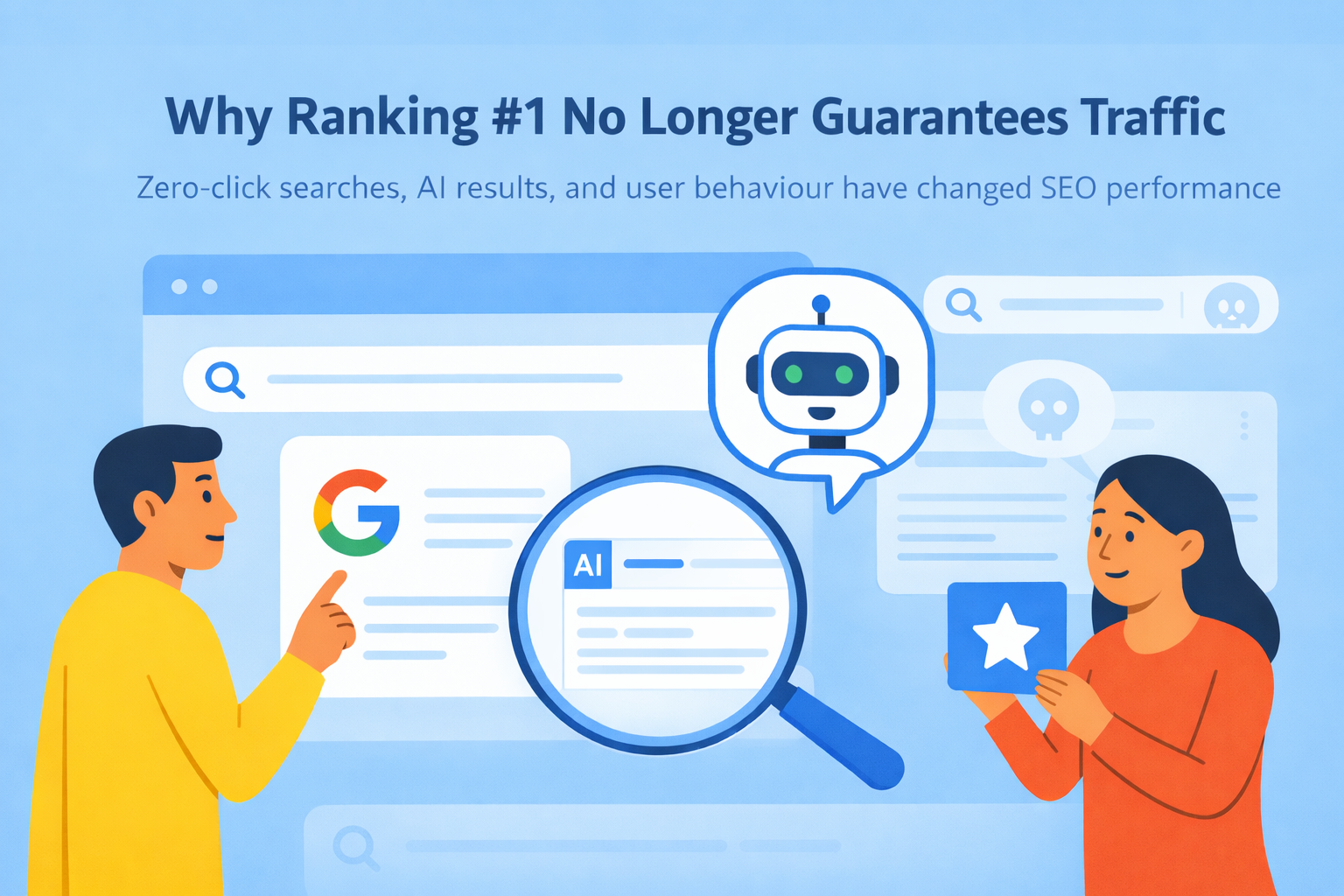
For a long time, ranking number one on Google felt like winning the internet.
If your page sat at the top of the results, traffic followed almost automatically. Reports looked healthy, graphs went up and to the right, and SEO success felt easy to define.
Today, many businesses are discovering an uncomfortable truth: ranking #1 no longer guarantees traffic. In some cases, it doesn’t even guarantee visibility.
This isn’t because SEO is broken. It’s because search itself has fundamentally changed.
The Search Results Page Is No Longer a Simple Gateway
Search results used to act as a gateway to websites. Their job was to send users elsewhere.
Modern results pages are designed to keep users where they are.
Between paid ads, map listings, featured snippets, image packs, videos, “People also ask” sections, and AI-generated answers, organic listings now compete for attention rather than default clicks. Even a first-position ranking can be pushed far below the fold, especially on mobile.
In this environment, ranking determines placement, not prominence.
Zero-Click Searches Are Now the Norm
A growing percentage of searches end without a click. Users get what they need directly from the results page and move on.
For informational queries, Google often surfaces the answer instantly. For local intent, map packs and business profiles absorb the interaction. For commercial research, comparison features and rich results reduce the need to visit individual websites.
When this happens, ranking #1 still exists — but the opportunity for traffic does not.
User Attention Has Become Selective
Users no longer scan search results evenly. They skim, filter, and make snap decisions based on familiarity and perceived trust.
A well-known brand ranking second or third can outperform an unknown brand in first position simply because users recognise the name. Meanwhile, unfamiliar results are often ignored, even when they technically rank highest.
This is why visibility is increasingly tied to brand recognition, not just position.
AI Overviews Change the Role of Rankings
AI-generated answers introduce another layer of complexity.
When an AI Overview summarises a topic at the top of the page, it reshapes the entire user journey. The summary becomes the primary interaction, while organic listings act as optional references.
In these cases, ranking #1 may mean appearing under the answer rather than as the answer. Traffic depends less on position and more on whether users feel a reason to click beyond the summary.
For many queries, that reason no longer exists.
Rankings Measure Relevance, Not Demand
Another overlooked issue is that rankings don’t measure demand.
A page can rank first for a keyword that receives impressions but very few meaningful clicks. Search volume might look healthy on paper, yet actual user intent may be weak or satisfied elsewhere on the page.
This creates a false sense of success. Reports show strong rankings, but traffic and enquiries fail to follow.
The problem isn’t performance — it’s expectation.
Click-Through Rate Matters More Than Ever
Google pays close attention to how users interact with results.
If a #1 ranking consistently fails to attract clicks, it sends a signal that something isn’t resonating. Over time, this can erode visibility, regardless of position.
Titles, brand recognition, perceived relevance, and result formatting now play a much bigger role in performance than raw rank alone.
Being first is no longer enough. You have to be chosen.
Traffic Without Intent Has Little Value Anyway
It’s also worth questioning the goal itself.
Not all traffic is useful. Ranking #1 for broad, low-intent queries may drive visits, but not outcomes. Meanwhile, lower-ranking pages targeting high-intent searches often deliver more value.
Modern SEO success is less about volume and more about alignment — matching the right content to the right stage of the user journey.
In that context, losing traffic from low-value searches may not be a loss at all.
What This Means for SEO Strategy
If ranking #1 no longer guarantees traffic, then SEO strategy must evolve.
Success now depends on:
- understanding how SERP layouts affect attention,
- creating content that offers a reason to click beyond the summary,
- building brand recognition within search,
- and measuring outcomes, not just positions.
Rankings still matter, but they are no longer the destination. They are one signal in a much larger system.
A Final Thought
SEO hasn’t become harder — it has become more honest.
Ranking #1 no longer masks weak intent, poor differentiation, or lack of trust. It simply reflects relevance within a results page designed to satisfy users quickly.
The businesses that succeed are those that stop chasing positions and start designing for decisions.
Because in modern search, being visible is easy. Being chosen is the real challenge.
Work With Leadtap
If your website ranks well but traffic and enquiries don’t reflect it, the issue is rarely “just SEO”. Leadtap is a digital marketing agency that helps businesses adapt to modern search realities — from understanding zero-click behaviour to building content and brand signals that earn clicks, not just positions. If you want your search performance to translate into real business outcomes, the Leadtap team can help you realign strategy with how search actually works today.