For years, digital marketing success was easy to define.
More rankings led to more traffic, and more traffic led to growth.
That logic is now being quietly challenged.
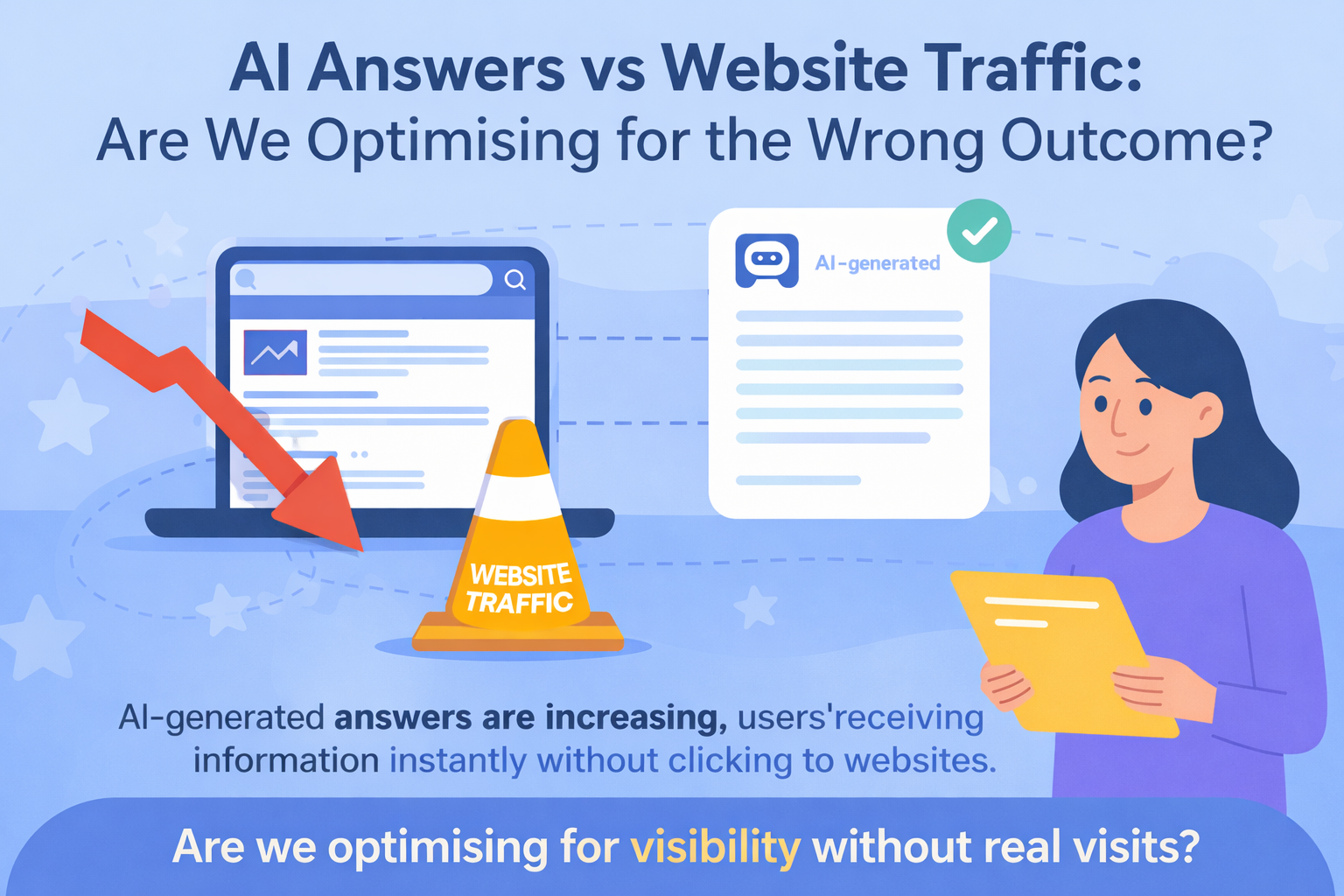
As AI-generated answers become more prominent across search engines and discovery platforms, many businesses are seeing a paradox: their content influences search results, yet website traffic stagnates or even declines. Information is being delivered instantly, often without a click.
This raises an uncomfortable but necessary question: are we optimising for the wrong outcome?
The Shift from Search Results to Search Resolution
Search engines no longer exist simply to list options. Their primary goal is to resolve queries as efficiently as possible.
AI answers accelerate this shift. Instead of sending users to multiple websites, search engines summarise information directly on the results page. For users, this feels helpful. For businesses, it changes the role their websites play.
Traffic is no longer the default reward for relevance. In many cases, being useful now means being invisible.
Visibility Without Visits
One of the biggest misunderstandings around AI answers is the assumption that visibility and traffic are the same thing.
They are not.
Your content may be read, understood, and used by AI systems to generate summaries, while your analytics show no corresponding increase in visits. From the platform’s perspective, the content has done its job. From the business perspective, the value feels lost.
This creates tension between influence and attribution. Your expertise shapes the answer, but your website never becomes part of the journey.
When Traffic Stops Being the Primary Signal
Traffic has always been a convenient metric because it was measurable and familiar. But in an AI-driven environment, traffic alone no longer tells the full story.
A decline in visits doesn’t necessarily mean a decline in relevance. It may simply mean that the search journey ended earlier.
At the same time, chasing traffic for its own sake can lead to strategies that optimise for clicks rather than outcomes, broad queries, low intent searches, and content that attracts attention but not decisions.
This is where many optimisation efforts quietly lose focus.
The Risk of Optimising Only for AI Answers
There is a growing temptation to optimise content purely to be summarised by AI.
While this can increase exposure, it also carries risk. Content designed solely for summarisation often becomes generic, stripped of nuance, and disconnected from the brand behind it. Over time, businesses may find themselves contributing knowledge without building recognition, trust, or demand.
In this scenario, AI benefits, users benefit but the business does not.
Optimisation without a clear commercial pathway is not strategy. It’s contribution without return.
Traffic That Converts vs Traffic That Flatters
Not all traffic is equal.
AI answers tend to absorb low-intent informational queries, leaving fewer but more meaningful opportunities for websites to engage users who are ready to act. This naturally reduces volume, but it can improve quality.
The mistake many businesses make is viewing reduced traffic as failure, rather than asking whether the remaining traffic is more aligned with real outcomes.
Fewer visits with clearer intent often outperform higher volumes with no direction.
Rethinking What “Success” Looks Like
If AI answers continue to expand, success can no longer be measured purely by sessions and page views.
Instead, businesses need to consider:
- whether their brand is recognised and trusted,
- whether users search for them directly,
- whether content influences decisions, not just discovery,
- and whether visibility leads to demand, even without immediate clicks.
This doesn’t mean abandoning SEO. It means reframing its purpose.
SEO becomes less about capturing every visit and more about owning the moments that matter.
Designing Content for Both AI and Humans
The real challenge is balance.
Content must be clear enough for AI to understand and summarise, but distinctive enough for users to seek out the source. It must answer questions efficiently while also signalling depth, expertise, and identity.
The goal isn’t to avoid AI answers. It’s to ensure that when AI answers appear, your brand remains relevant, recognisable, and worth exploring further.
That requires intentional strategy, not reactive optimisation.
A Final Thought
AI answers aren’t stealing traffic. They’re revealing a deeper truth about how people search.
Users don’t want more pages. They want clarity.
The businesses that succeed in this environment will be those that stop measuring success by volume alone and start optimising for influence, trust, and long-term demand.
Because in the age of AI, traffic is optional and relevance is not.
Work With Leadtap, digital marketing agency
If AI answers are changing how your content performs and traffic no longer reflects your true influence, it may be time to rethink what optimisation means. Leadtap is a digital marketing agency that helps businesses balance AI visibility with meaningful website engagement ensuring your content builds authority, demand, and measurable outcomes, not just summaries. If you want a strategy that aligns search performance with real business growth, the Leadtap team is here to help.