Building a website in 2026 means satisfying three demanding and occasionally competing masters simultaneously. Your site must load fast enough to meet Google’s Core Web Vitals thresholds and pass the patience test of a mobile user on a 4G connection. It must be structured, marked up and crawlable in ways that allow search engines to index and rank it effectively. And it must present a user experience so clear, so intuitive and so well-designed that visitors stay, engage and convert rather than bouncing back to the search results within seconds.
The tension between these three requirements is real. A visually ambitious design often adds weight that degrades loading performance. SEO requirements – semantic HTML, structured content hierarchies, crawlable internal links – sometimes conflict with the interaction patterns that UX designers prefer. Performance optimisation can strip out the visual richness that makes a brand feel premium.
A specialist web development agency navigates these tensions deliberately, making informed trade-offs rather than prioritising one dimension at the expense of the others. Understanding how they do this – and why getting it right matters – is essential for any business commissioning a new website or evaluating an existing one.
Why Speed, SEO and UX Are Interdependent
The temptation is to think of speed, SEO, and UX as separate work-streams that can be addressed sequentially. Build the design first, then optimise for speed, then add SEO. In practice, this approach reliably produces a website that is compromised on all three dimensions, because decisions made early in the process – during design and development – have downstream consequences that are expensive or impossible to reverse.
A large hero image chosen during the design phase may deliver the visual impact a client wants, but if it is not optimised for web delivery during development, it becomes the single biggest contributor to a slow Largest Contentful Paint score – a direct ranking factor. A JavaScript-heavy interactive feature that looks impressive in a prototype may prevent search engine crawlers from indexing the page’s content, because the crawler cannot execute the script. A navigation structure that feels intuitive to the design team may bury conversion-critical pages three or four clicks deep, creating an SEO architecture problem that reduces the authority of key commercial pages.
These are not edge cases. They are among the most common website failures, and they almost always stem from treating speed, SEO and UX as separate concerns rather than an integrated problem to be solved together.
Core Web Vitals: What They Mean in Practice
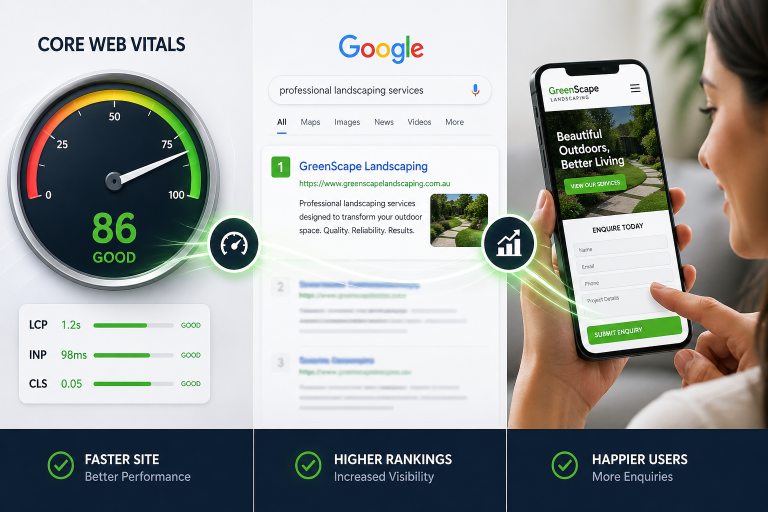
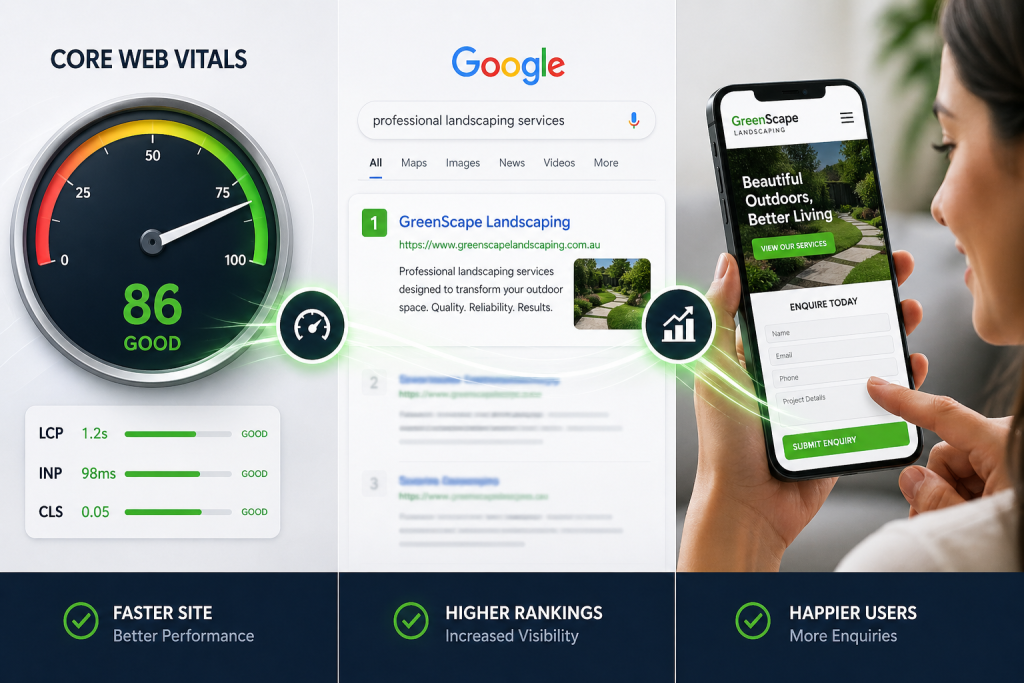
Google’s Core Web Vitals are the clearest expression of what the search engine considers a high-quality web experience. In 2026, three metrics form the assessment:
Largest Contentful Paint (LCP) measures how long it takes for the largest visible element on the page – typically a hero image or headline – to load fully. The target is under 2.5 seconds. A well-optimised page achieves this through a combination of image compression, modern formats (WebP, AVIF), lazy loading for below-the-fold content, efficient server response times and content delivery network (CDN) caching.
Interaction to Next Paint (INP) replaced First Input Delay in 2024 and measures the responsiveness of a page to user interactions throughout the entire session – not just on first load. A slow INP score typically indicates JavaScript that is blocking the main thread, preventing the browser from responding promptly to clicks, taps and key presses. The solution requires careful JavaScript architecture: code splitting, deferring non-critical scripts and minimising long tasks.
Cumulative Layout Shift (CLS) measures visual stability – specifically, how much the page layout shifts unexpectedly as content loads. A high CLS score is caused by images without explicit dimensions, dynamically injected content and web fonts that cause text to reflow. Solving it requires explicit dimension declarations, font loading strategies that prevent layout jumps, and careful management of dynamic content insertion.
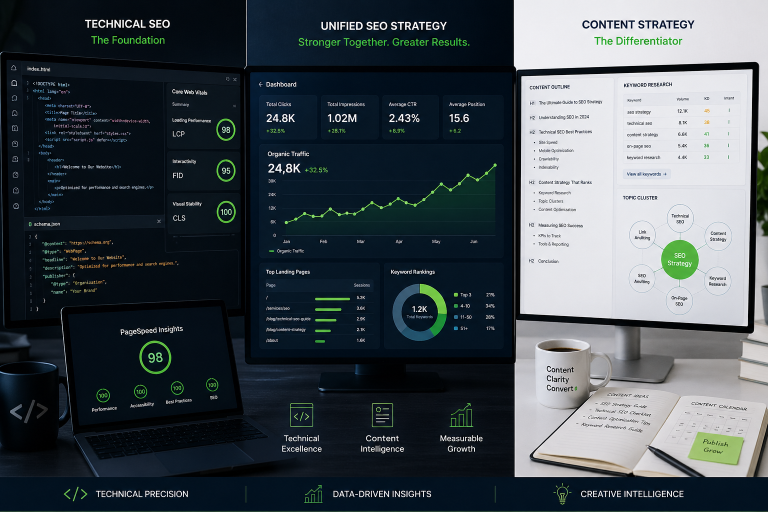
A web development agency does not treat Core Web Vitals as an afterthought. It builds performance targets into the technical specification from the outset and validates them throughout development using tools such as Google PageSpeed Insights, Lighthouse and real-user monitoring.
Balancing Performance Optimisation and Design Richness
One of the most common points of friction between web development agencies and their clients is the tension between visual ambition and performance reality. Clients see beautifully designed websites and want the same level of visual richness. Developers know that full-screen video backgrounds, complex animations, custom typefaces and high-resolution imagery all carry performance costs.
The resolution is not to strip out visual richness – it is to implement it intelligently. Modern web development techniques allow for genuinely impressive visual experiences without the performance penalties that would have made them impossible five years ago:
Next-generation image formats (WebP and AVIF) deliver the same visual quality as JPEG or PNG at a fraction of the file size. Serving these formats to browsers that support them – with appropriate fallbacks for those that do not – maintains visual fidelity while dramatically reducing page weight.
CSS animations over JavaScript animations perform significantly better on the GPU and avoid blocking the main thread. A web development agency uses CSS for decorative animations and reserves JavaScript for interactions that genuinely require it.
Variable fonts allow a single font file to contain multiple weights and styles, reducing the number of font-loading requests and eliminating the layout shifts caused by font swaps.
Progressive enhancement builds a core experience that works beautifully on all devices and connection speeds, then layers additional richness for users whose devices and connections can support it.
Mobile-First Development: The Non-Negotiable Starting Point
In 2026, mobile-first development is not a best practice – it is the minimum requirement. Google indexes the mobile version of your website, not the desktop version. The majority of web traffic for most businesses arrives on mobile devices. A website that delivers an excellent desktop experience but a compromised mobile experience is failing the majority of its visitors and sending negative signals to the search engine that matters most.
Mobile-first development means designing and building for small screens first, then expanding the experience for larger displays – not the reverse. It requires deliberate decisions about tap target sizes, font sizes at mobile viewports, the order of content in the DOM and the management of JavaScript that may behave differently on mobile processors. A web development agency that builds desktop-first and then “makes it responsive” is working backwards.
How Leadtap Delivers Websites That Perform on All Three Dimensions
Leadtap’s web development approach begins with a brief that covers all three performance dimensions simultaneously – speed targets, SEO requirements and UX objectives – before a single line of code is written. This integration means that trade-offs are identified and resolved early, rather than discovered as expensive problems at the end of a project.
Technical architecture decisions – hosting environment, build framework, image delivery, JavaScript strategy – are made with Core Web Vitals targets in mind from the outset. Information architecture and URL structure are planned to support SEO objectives before the design phase begins. UX wireframes are tested for navigational clarity and conversion logic before they are handed to developers.
The result is a website that does not need to be rebuilt six months after launch because a performance audit has revealed that the beautiful hero video is costing three seconds of LCP. It works as intended from day one, because all three dimensions were treated as a single problem from the beginning.
For businesses that want a website that is genuinely fast, genuinely visible and genuinely effective at converting visitors into customers, Leadtap’s web development agency team is the right partner. Visit [www.leadtap.ai](https://www.leadtap.ai/) to learn more.