One of the quietest shifts in modern search is also one of the most unsettling for businesses.
Your website may still be indexed.
Your content may still be accurate.
Your rankings may not even have dropped dramatically.
And yet, when AI-generated answers appear whether in search engines, assistants, or discovery tools your site is nowhere to be seen.
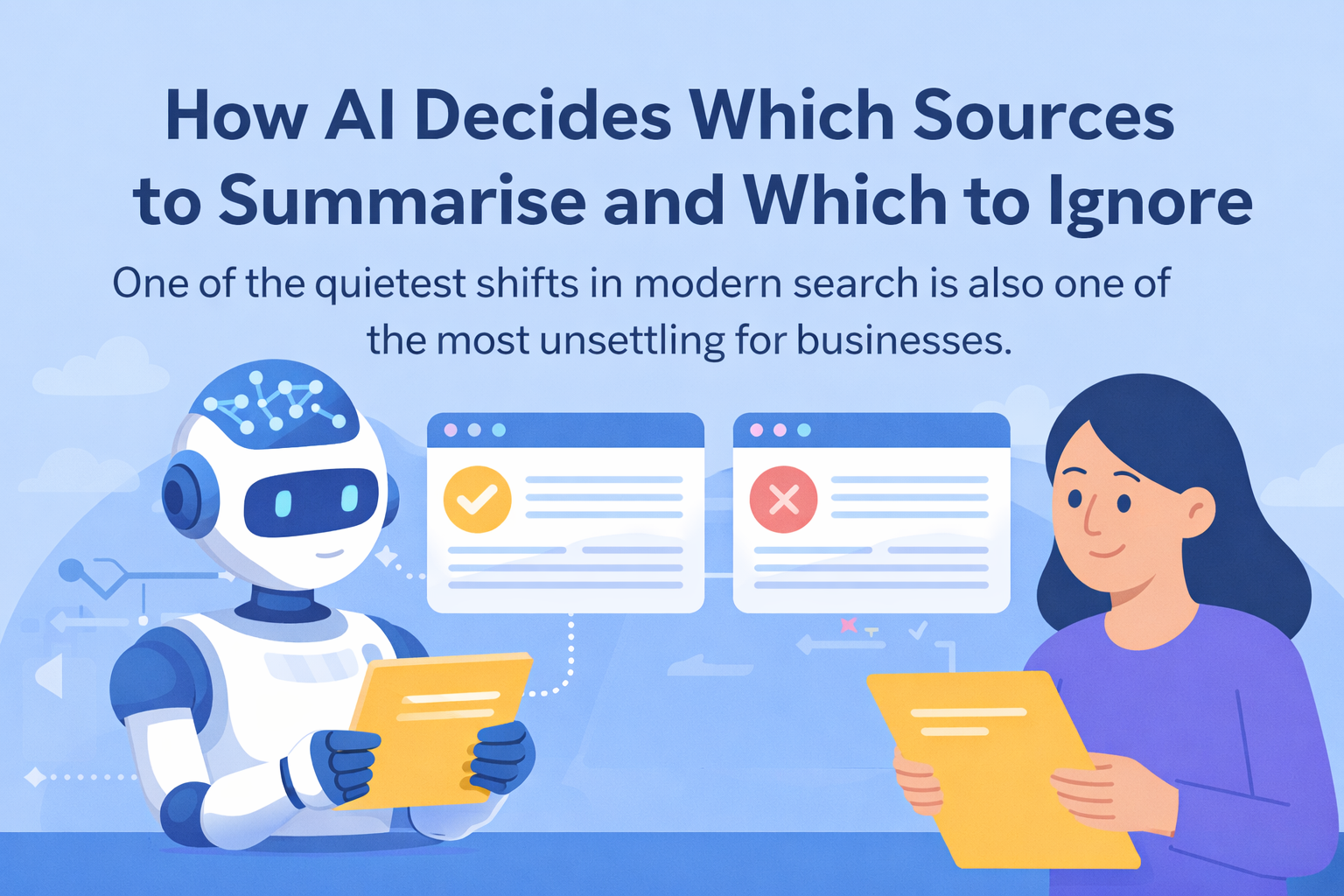
This isn’t random. AI systems don’t summarise the web evenly. They make selective decisions about which sources are worth absorbing, compressing, and re-presenting and which can be safely ignored.
Understanding how those decisions are made is no longer optional. It’s fundamental to staying visible in an AI-shaped search landscape.
AI Is Not “Reading” the Web Like a Human
The first misconception to clear up is this: AI does not browse the internet the way people do.
It doesn’t scroll, compare ten tabs, or weigh arguments emotionally. Instead, it looks for patterns, consistency, and signals of reliability at scale. Its goal is not to discover new opinions, but to reduce uncertainty and deliver confident answers.
That means AI systems naturally favour sources that:
- appear stable and predictable,
- align with established understanding,
- and reduce the risk of being wrong.
From this perspective, ignoring certain sources is not a flaw it’s a feature.
Why Some Sources Are Easier for AI to Use
AI systems work best with content that is clear, structured, and repeatable.
When a source explains a topic in a way that is logically organised, internally consistent, and aligned with how others explain the same subject, it becomes easy to summarise. The AI can compress it without distortion.
By contrast, content that is vague, scattered, overly opinionated, or poorly structured introduces friction. Even if it’s insightful, it’s harder to distil safely.
As a result, AI tends to favour sources that behave like reference material, not those that read like marketing copy or loosely connected blog posts.
Authority Is Inferred, Not Declared
A common mistake businesses make is assuming that authority comes from claiming expertise.
AI systems don’t respond well to self-assertion. They infer authority indirectly, through signals such as:
- topical depth across multiple related pages,
- consistent framing of ideas over time,
- alignment with other trusted sources,
- and clarity around who is responsible for the content.
If a website talks about many topics shallowly, or changes tone and positioning frequently, it becomes harder for AI to classify it as a reliable source.
This is one reason why some smaller sites are summarised while larger ones are ignored: clarity often beats scale.
Consistency Beats Originality More Often Than You Think
From a human perspective, originality is valuable. From an AI perspective, consistency is often safer.
AI systems are designed to avoid hallucination and misinformation. That means they are cautious about amplifying ideas that sit too far outside the mainstream understanding of a topic unless those ideas are strongly supported by recognised sources.
Content that explains widely accepted concepts clearly and accurately is more likely to be summarised than content that is novel but weakly connected to existing knowledge.
This doesn’t mean originality is punished. It means originality must be anchored grounded in context, evidence, and clear reasoning to be usable by AI.
The Role of Entity Clarity
AI doesn’t just evaluate pages. It evaluates entities.
An entity can be a brand, a person, a product, or a clearly defined concept. When AI understands who or what is behind a piece of content, it can place that information within a broader knowledge framework.
Websites that lack clear identity no consistent brand voice, no visible authorship, no defined focus are harder to model as entities. As a result, their content is less likely to be selected for summarisation.
This is why brand clarity increasingly matters even in informational content. Anonymous usefulness is harder for AI to trust than identifiable expertise.
Redundancy Is Not a Virtue in AI Selection
If your content says the same thing as hundreds of other pages, AI has little reason to include it.
Even if the information is correct, it adds no additional value to the summary. AI systems prioritise sources that help them explain better, not just repeat accurately.
This is where many SEO-driven blogs fall short. They are optimised to rank, but not to differentiate. From an AI’s point of view, they are interchangeable.
When summarising, AI doesn’t ask, “Which page ranks highest?”
It asks, “Which sources help me explain this clearly with the least risk?”
Structural Signals Matter More Than Keywords
Traditional SEO trained businesses to think in terms of keywords. AI systems think in terms of relationships.
How concepts connect.
How ideas flow.
How one explanation supports another.
Content that demonstrates these relationships through internal linking, thematic depth, and logical progression is easier for AI to absorb and reuse.
This is why isolated blog posts often fail to appear in AI summaries, while well-connected content hubs perform better. AI prefers knowledge systems over standalone articles.
Why Some Good Content Is Still Ignored
Perhaps the most frustrating reality is this: content can be good, accurate, and helpful and still be ignored by AI.
This usually happens when:
- the site lacks topical authority,
- the content sits outside a clear thematic focus,
- the brand has little recognisable presence,
- or the explanations are correct but generic.
From a business perspective, this feels unfair. From an AI perspective, it’s simply risk management.
AI is optimised to be confident, not comprehensive.
Visibility vs Influence: An Uncomfortable Trade-Off
Another difficult truth is that being summarised does not always mean being credited.
AI systems may absorb ideas, patterns, and explanations from your content without linking back directly. Your influence increases, but your traffic does not.
This creates a new challenge for businesses: how to be both useful to AI and visible to humans.
The answer lies not in chasing summaries, but in building recognisable authority so that when AI does reference sources, your brand is one of the few it can confidently name.
What This Means for Content Strategy
If AI decides which sources to summarise and which to ignore then content strategy must evolve.
The goal is no longer just to rank or inform. It is to become structurally useful to AI systems while remaining valuable to human readers.
That requires:
- depth over breadth,
- clarity over cleverness,
- consistency over volume,
- and identity over anonymity.
Content that meets those criteria stands a far better chance of being included in AI-driven answers and remembered beyond a single search.
A Final Thought
AI doesn’t ignore websites out of malice or oversight. It ignores them because they are difficult to classify, summarise, or trust at scale.
In the age of AI search, visibility is no longer earned solely by optimisation. It is earned by becoming a source that systems can rely on when simplifying the world for users.
The question businesses must now ask is not “Why isn’t AI showing my content?”
It’s “Have I given AI a clear reason to use me at all?”
If navigating AI-driven search, brand visibility, and evolving SEO feels increasingly complex, you don’t have to figure it out alone. Leadtap is a digital marketing agency that helps businesses adapt to modern search realities from building recognisable authority to creating content that earns visibility across both traditional and AI-powered platforms. If you’d like a clearer, more sustainable approach to digital growth, you can get in touch with the Leadtap team to explore how we can support you.