For many businesses, SEO still feels like a simple equation: create good content, optimise keywords, and wait for Google to reward you with visibility. Yet increasingly, even well-written, technically sound pages fail to appear at all. Not on page one. Not on page ten. Sometimes, not anywhere meaningful.
This isn’t always a ranking problem. More often, it’s a visibility decision.
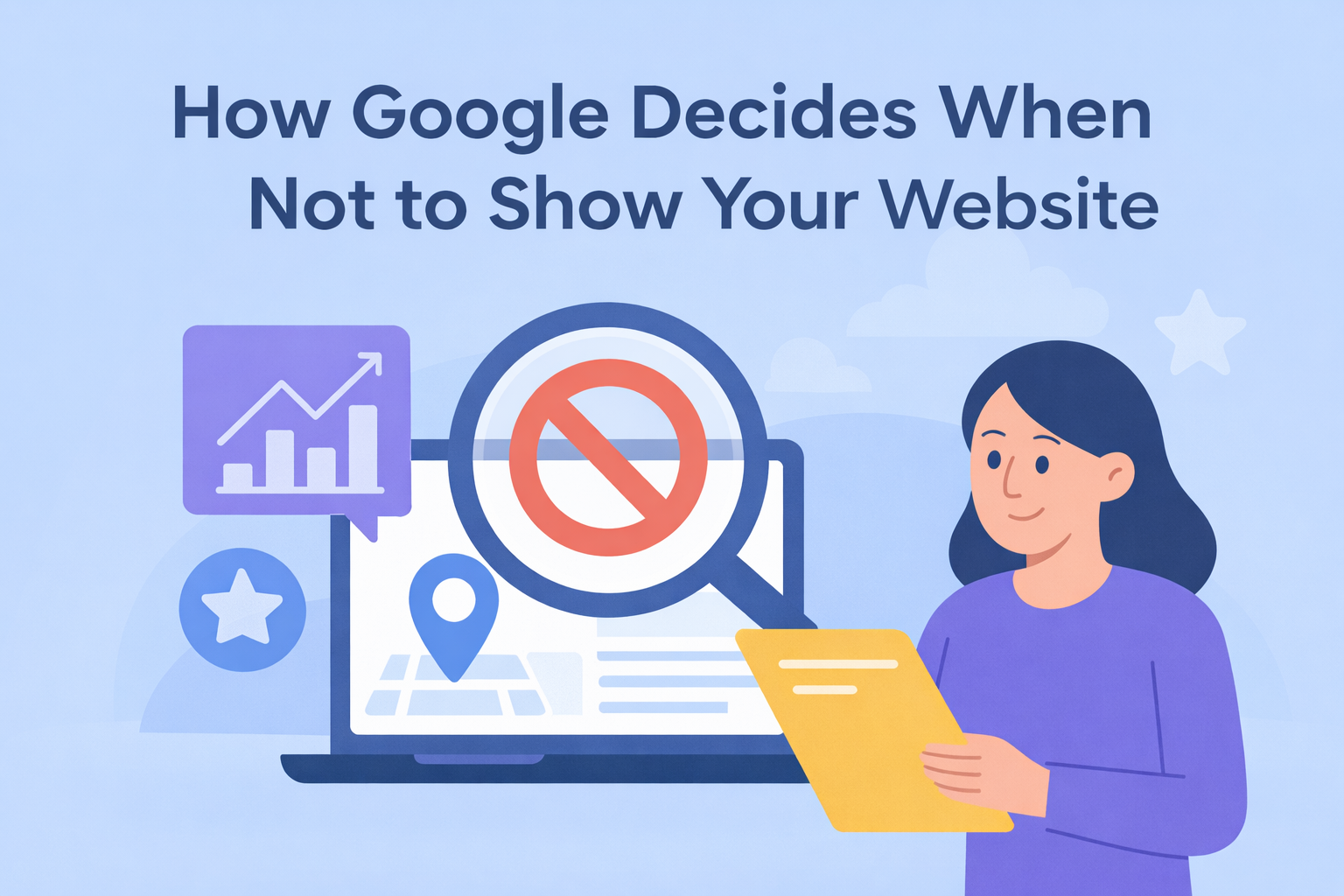
Modern search engines don’t just decide where to rank your website, they also decide whether your website should be shown in the first place. Understanding that distinction is crucial if you want to remain visible in a search landscape shaped by AI, intent modelling, and zero-click experiences.
Let’s unpack how and why Google decides not to show certain websites, even when they seem to “do everything right”.
Search Is No Longer About Listing Pages
Google’s original job was to retrieve documents. Today, its job is to resolve intent.
When someone searches, Google isn’t asking “Which pages match these words?”
It’s asking “What is the fastest, safest way to satisfy this user?”
Sometimes, the answer is a list of websites.
Sometimes, it’s a map pack, a product carousel, a featured snippet, or an AI-generated summary.
And sometimes, it’s no external website at all.
If Google believes a result page would add friction rather than value, it may simply decide not to show one.
This is the first mental shift many businesses struggle with: absence from results doesn’t always mean poor quality it often means perceived irrelevance to the outcome Google is trying to deliver.
When Google Thinks a Click Isn’t Necessary
One of the most common reasons a website doesn’t appear is that Google believes the query can be resolved without a click.
Straightforward informational searches, definitions, dates, conversions, basic explanations are increasingly handled directly on the results page. Featured snippets, knowledge panels, and AI Overviews exist precisely to reduce the need for further exploration.
If your page simply repeats what Google can already summarise confidently, it may be excluded entirely, regardless of how well it’s written.
This doesn’t mean informational content is useless. It means content that only informs, without guiding or contextualising, is easy to replace.
Intent Mismatch: The Quiet Visibility Killer
Another common reason websites aren’t shown is intent mismatch.
You may believe a keyword is relevant to your business, but Google may classify it very differently. For example, a query that sounds commercial may be interpreted as informational. A search that looks educational may actually be navigational or transactional.
When that happens, Google filters out pages that don’t match the dominant intent not because they’re bad, but because they’re misaligned.
This is why many “perfectly optimised” pages never surface: they answer a question the user didn’t actually ask, at least not in Google’s interpretation.
Redundancy in a Crowded Content Landscape
The internet doesn’t suffer from a lack of content. It suffers from repetition.
If your page doesn’t introduce a new angle, deeper clarity, lived expertise, or practical guidance, Google may see it as redundant. In those cases, showing your site doesn’t improve the search experience, it simply adds noise.
This is especially true in industries flooded with templated blog content. Even strong writing can disappear if it doesn’t move the conversation forward.
From Google’s perspective, not showing your page can be an act of quality control.
Trust Signals That Block Visibility Before Ranking Begins
Sometimes, a page isn’t shown because Google isn’t confident enough to surface it even if it hasn’t actively penalised it.
This can happen when:
- the website lacks clear authorship or accountability
- the brand has no visible footprint beyond its own site
- content exists in isolation, without topical support
- important pages are buried or poorly connected
In these cases, Google may crawl and index the page but choose not to surface it meaningfully. The site exists, but it doesn’t feel reliable enough to recommend.
This is an important distinction: indexing is permission to exist; visibility is earned trust.
Structural Signals Matter More Than Ever
In an AI-driven search environment, Google needs to understand your website, not just read it.
Poor internal linking, thin service pages, unclear hierarchy, or scattered topical coverage all make it harder for Google to determine when your site should be shown.
If the system can’t confidently place your page within a broader topic or journey, it may decide it’s safer not to show it at all.
This is why visibility is increasingly a site-wide outcome, not a page-by-page reward.
The Rise of “Invisible Authority”
One of the more uncomfortable truths for businesses is this: your content may influence search without ever being seen.
AI systems can absorb ideas, patterns, and explanations from your site and use them to generate answers without sending traffic back. In those cases, your website contributes to the ecosystem, but not to your analytics.
Google doesn’t see this as exclusion. It sees it as efficiency.
For businesses, however, it’s a signal that being useful isn’t the same as being visible and strategy must adapt accordingly.
What This Means for Businesses Going Forward
If Google can decide not to show your website, then SEO can no longer be about chasing rankings alone.
Visibility today depends on:
- whether your content adds something Google can’t easily replicate
- whether your site demonstrates depth, not just coverage
- whether your pages help users make decisions, not just gain information
- whether your brand feels trustworthy enough to recommend
The question to ask is no longer “Why am I not ranking?”
It’s “Why would Google choose to show me at all?”
That shift from optimisation to justification is where modern SEO now lives.
A Final Thought
Google isn’t hiding your website out of spite, nor is it broken when visibility drops without explanation. It’s making continuous judgement calls about usefulness, trust, and efficiency.
The businesses that thrive in this environment aren’t those producing more content, they’re the ones producing content that earns a reason to exist in the results.
If your website disappears, it’s not always a failure. Sometimes, it’s feedback quietly telling you what needs to change.