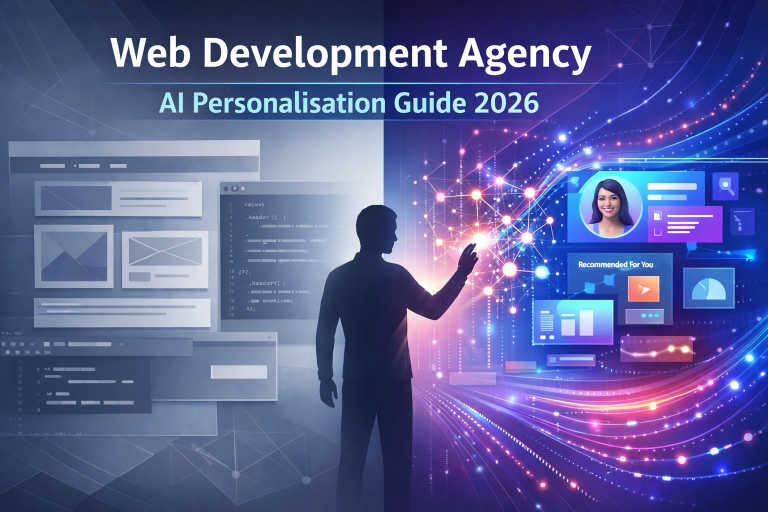
In 2026, AI personalisation will fundamentally transform how users interact with websites, with 73% of designers viewing AI as their primary design collaborator. A forward-thinking web development agency that masters real-time adaptive experiences and intelligent user interfaces will dominate the digital landscape. The shift towards personalised, intelligent web experiences isn’t just a trend, it’s becoming the baseline expectation for users who demand relevance, intuition and instant gratification from every digital interaction.
The convergence of artificial intelligence and web development is creating unprecedented opportunities for agencies to deliver truly transformative user experiences. As we approach 2026, the agencies that embrace AI personalisation now will establish themselves as industry leaders, whilst those that hesitate risk being left behind in an increasingly competitive marketplace.
The 2026 AI Personalisation Revolution: What Every Web Development Agency Must Know
The digital landscape is experiencing a seismic shift as AI personalisation becomes the cornerstone of exceptional user experiences. Current data reveals that 36% of designers are already actively building AI-powered personalisation into their work, with adoption rates accelerating rapidly as we approach 2026. This transformation represents more than technological advancement; it’s a fundamental reimagining of how websites interact with users.
Real-Time Adaptive Experiences Becoming Standard
The age of rigid, one-size-fits-all websites is quickly fading. Modern users expect websites to respond intelligently to their behaviour, preferences and context within milliseconds of interaction. AI systems now combine activity across multiple devices to recognise visitors and understand their intent, creating seamless experiences that adapt in real-time.
Cross-device user recognition has evolved beyond simple cookie tracking to sophisticated behavioural pattern analysis. When a user browses product categories on their mobile device during lunch and returns via desktop in the evening, AI personalisation systems instantly recognise the continuation of their journey. The website adapts its layout, prioritises relevant content and streamlines the path to conversion based on this accumulated understanding.
The Shift from Static to Dynamic User Interfaces
Dynamic user interfaces represent the next evolution in web design, where every element from navigation menus to content hierarchy adjusts based on user identity, intent and context. This shift demands that a modern web development agency fundamentally rethink traditional design principles in favour of flexible, AI-driven architectures.
The competitive advantage of early AI adoption cannot be overstated. Agencies implementing these technologies today position themselves as innovation leaders, attracting clients who recognise the strategic importance of staying ahead of user expectations. As 32% of designers predict adaptive interfaces will have a major impact in 2026, the window for early adoption advantage is narrowing rapidly.
How AI Understands and Responds to User Intent in Real-Time
Understanding user intent requires sophisticated analysis of multiple data streams, from click patterns and scroll behaviour to dwell time and interaction sequences. AI systems excel at identifying subtle signals that indicate user preferences, frustrations and objectives, enabling websites to respond proactively rather than reactively.
Behavioural Pattern Recognition and Analysis
Advanced behavioural pattern recognition systems analyse micro-interactions to build comprehensive user profiles. When a visitor consistently ignores carousel elements but engages deeply with static content blocks, the AI system learns to deprioritise dynamic elements for similar user profiles. This level of granular analysis enables personalisation that feels intuitive rather than intrusive.
The sophistication of modern AI allows for real-time sentiment analysis based on user behaviour. Rapid clicking might indicate frustration, prompting the system to simplify navigation options. Extended hover states could suggest interest, triggering the display of additional relevant information. These behavioural insights enable websites to adapt their presentation dynamically.
Contextual Content Delivery Systems
Contextual content delivery extends beyond basic demographic targeting to consider factors like time of day, device type, geographic location and browsing history. A professional services website might prioritise different content for mobile users during commuting hours versus desktop users during traditional business hours, understanding that context influences both need and attention span.
Intelligent content delivery systems also consider the user’s position within the customer journey. First-time visitors receive introductory content and clear value propositions, whilst returning visitors might see advanced features, case studies or conversion-focused messaging. This contextual awareness eliminates friction and accelerates the path to desired outcomes.
Predictive Design Elements
Predictive design elements anticipate user needs before they’re explicitly expressed. AI systems analyse patterns to predict which information users will seek next, preloading content and adjusting interface elements accordingly. This proactive approach reduces cognitive load and creates experiences that feel almost telepathic in their responsiveness.
The integration of predictive elements requires careful balance; too much anticipation can feel invasive, whilst too little fails to leverage AI’s potential. Successful implementation focuses on subtle enhancements that improve usability without drawing attention to the underlying technology.
Building Intelligent Websites That Adapt Without Compromising Privacy
The challenge of delivering personalised experiences whilst respecting user privacy represents one of the most critical considerations for any web development agency implementing AI personalisation. Success requires sophisticated technical approaches that maximise personalisation benefits whilst maintaining user trust and regulatory compliance.
Privacy-First Personalisation Strategies
Privacy-first personalisation leverages techniques like federated learning and edge computing to process user data locally rather than transmitting sensitive information to central servers. This approach enables sophisticated personalisation whilst keeping personal data under user control. Local processing also improves response times, creating better user experiences alongside enhanced privacy protection.
Transparent data usage frameworks establish clear boundaries around data collection and usage. Users understand exactly what information is being gathered, how it’s processed, and what benefits they receive in return. This transparency builds trust and often increases user willingness to share data that enables better personalisation.
Balancing User Data Collection with Trust
Building trust requires ongoing communication about data practices and user control over personalisation features. Effective implementations provide granular privacy controls, allowing users to adjust personalisation intensity or disable specific features whilst maintaining core functionality. This user agency strengthens the relationship between visitor and website.
Leadtap’s approach to AI-powered solutions demonstrates how agencies can implement sophisticated personalisation whilst maintaining ethical data practices. By prioritising user control and transparency, agencies build sustainable competitive advantages based on trust rather than data exploitation.
Agentic AI Systems: The Future of Web Development Workflows
Agentic AI systems represent the evolution from passive tools to active collaborators in the web development process. These systems don’t merely respond to developer commands; they anticipate needs, suggest optimisations and autonomously handle routine tasks, enabling human developers to focus on strategic and creative challenges.
AI-Powered Development Lifecycle Integration
The integration of AI throughout the development lifecycle transforms traditional workflows. AI systems generate code based on natural language descriptions, automatically write comprehensive test suites, and deploy applications with intelligent monitoring systems. This end-to-end integration reduces development time whilst improving code quality and reliability.
With 60% of designers believing AI agents will have major impact in 2026, the pressure to adopt these systems intensifies. Early adopters gain significant productivity advantages, enabling them to take on more complex projects and deliver results faster than competitors relying on traditional development approaches.
Automated Testing and Deployment Systems
Automated testing powered by AI goes beyond simple functional testing to include usability analysis, accessibility compliance and performance optimisation. AI systems can simulate diverse user behaviours, identifying potential issues that human testers might miss. This comprehensive testing approach improves user experiences whilst reducing post-launch problems.
Intelligent deployment systems monitor application performance in real-time, automatically scaling resources based on demand and identifying potential issues before they affect users. This proactive approach minimises downtime and ensures consistent user experiences even under varying load conditions.
Intelligent Monitoring and Optimisation
Post-deployment monitoring leverages AI to analyse user behaviour patterns, identify conversion barriers and suggest interface improvements. These systems provide actionable insights that inform iterative design improvements, creating a continuous optimisation cycle that improves results over time.
Implementing Generative AI Tools for Enhanced User Experiences
The widespread adoption of generative AI tools with 93% of designers currently implementing solutions like ChatGPT and Midjourney demonstrates the transformative potential of these technologies for creating dynamic, personalised user experiences.
ChatGPT and Content Personalisation Integration
ChatGPT integration enables dynamic content generation that adapts to user preferences and context. Rather than static content that serves all visitors identically, AI-powered systems generate personalised descriptions, recommendations and explanations that resonate with individual users. This personalisation extends to tone, complexity level and focus areas based on user behaviour analysis.
The seamless integration of generative AI requires careful consideration of brand voice consistency and content quality. Successful implementations establish clear guidelines and approval processes that maintain brand standards whilst leveraging AI efficiency and personalisation capabilities.
Midjourney for Dynamic Visual Adaptation
Visual personalisation through tools like Midjourney enables websites to adapt imagery based on user preferences, demographics or behaviour patterns. A travel website might generate destination imagery that emphasises different aspects of adventure activities for thrill-seekers or cultural experiences for history enthusiasts based on user profile analysis.
Dynamic visual adaptation must balance personalisation benefits with loading performance and user experience consistency. Effective implementations pre-generate personalised assets or use efficient real-time generation systems that don’t compromise page speed or visual quality.
Measuring Success: KPIs and Analytics for AI-Personalised Websites
Measuring the effectiveness of AI personalisation requires sophisticated analytics approaches that go beyond traditional metrics to capture the nuanced benefits of adaptive user experiences.
User Engagement Metrics for Personalised Experiences
Engagement metrics for personalised websites include traditional measures like time on page and conversion rates, but also incorporate personalisation-specific indicators such as content relevance scores and adaptive element effectiveness. These metrics help agencies understand which personalisation features provide genuine value versus those that merely increase complexity.
Advanced analytics systems track how personalisation affects user satisfaction over time, measuring factors like return visit frequency, engagement depth progression, and user-initiated interactions with personalised elements. This longitudinal analysis reveals the true impact of AI personalisation investments.
Conversion Rate Optimisation Through AI
AI-powered conversion rate optimisation continuously tests and refines personalisation algorithms based on real user outcomes. Rather than traditional A/B testing with fixed variations, AI systems explore vast possibility spaces to discover optimal personalisation strategies for different user segments.
The ROI tracking for AI implementation requires comprehensive measurement frameworks that capture both direct conversion improvements and indirect benefits like reduced support costs, increased customer lifetime value and improved brand perception. Leadtap’s data-driven approach to measuring AI solution effectiveness provides agencies with proven methodologies for demonstrating personalisation value to clients.
Conclusion
A top-tier web development agency that embraces AI personalisation now will lead the 2026 digital landscape, delivering unprecedented user experiences through intelligent, adaptive interfaces. The convergence of AI technology and user experience design creates opportunities for agencies to differentiate themselves dramatically from competitors still relying on traditional development approaches.
The statistics are clear: with 73% of designers viewing AI as their primary collaborator and 93% already implementing generative AI tools, the transformation is accelerating rapidly. Agencies that position themselves at the forefront of this revolution will capture the most attractive clients and projects, whilst establishing sustainable competitive advantages based on technological sophistication and superior user outcomes.
Success requires more than technological implementation; it demands strategic thinking about user privacy, ethical data usage and the balance between personalisation and user control. The agencies that master these complexities will become trusted partners for businesses seeking to create truly exceptional digital experiences.
Partner with experts who understand both the technical implementation and strategic implications of AI-powered personalisation. The future of web development is intelligent, adaptive and personalised and that future is arriving faster than many realise. Explore our services to discover how Leadtap can transform your digital presence, learn more about our approach, or contact us to discuss your project.
Sources
- Source 1: 73% of designers say AI as a design collaborator will have most impact in 2026 – Lyssna UX Design Trends 2026
- Source 2: 93% of designers implementing generative AI tools (ChatGPT, Midjourney) – Lyssna UX Design Trends 2026
- Source 3: 60% of designers believe AI agents will have major impact in 2026 – DesignRush Future of AI in Web Development