For years, search engine optimisation has been measured by a single, comforting metric: rankings. If your website appeared near the top of Google, visibility followed, traffic flowed, and enquiries usually came next.
That mental model no longer holds in the way it once did.
Modern search is not just about where you rank, but whether people recognise, trust, and choose your brand when it appears or even when it doesn’t. As search results become more crowded, more visual, and increasingly influenced by AI-generated answers, brand recognition has quietly become one of the strongest drivers of search performance.
Understanding this shift is essential for any business that wants to stay visible in today’s search environment.
Search Results Are No Longer Neutral Lists
Search results used to be a simple list of blue links. Users compared positions, clicked the top option, and moved on.
Today, search pages are decision environments.
Between ads, maps, featured snippets, AI Overviews, video results, and “People also ask” boxes, organic listings compete for attention rather than default clicks. In this environment, users don’t evaluate every option equally. They scan quickly, gravitate towards names they recognise, and ignore what feels unfamiliar or uncertain.
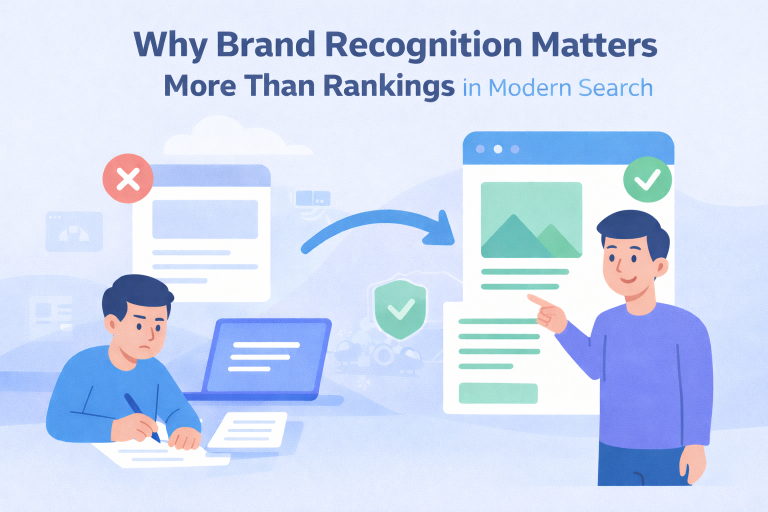
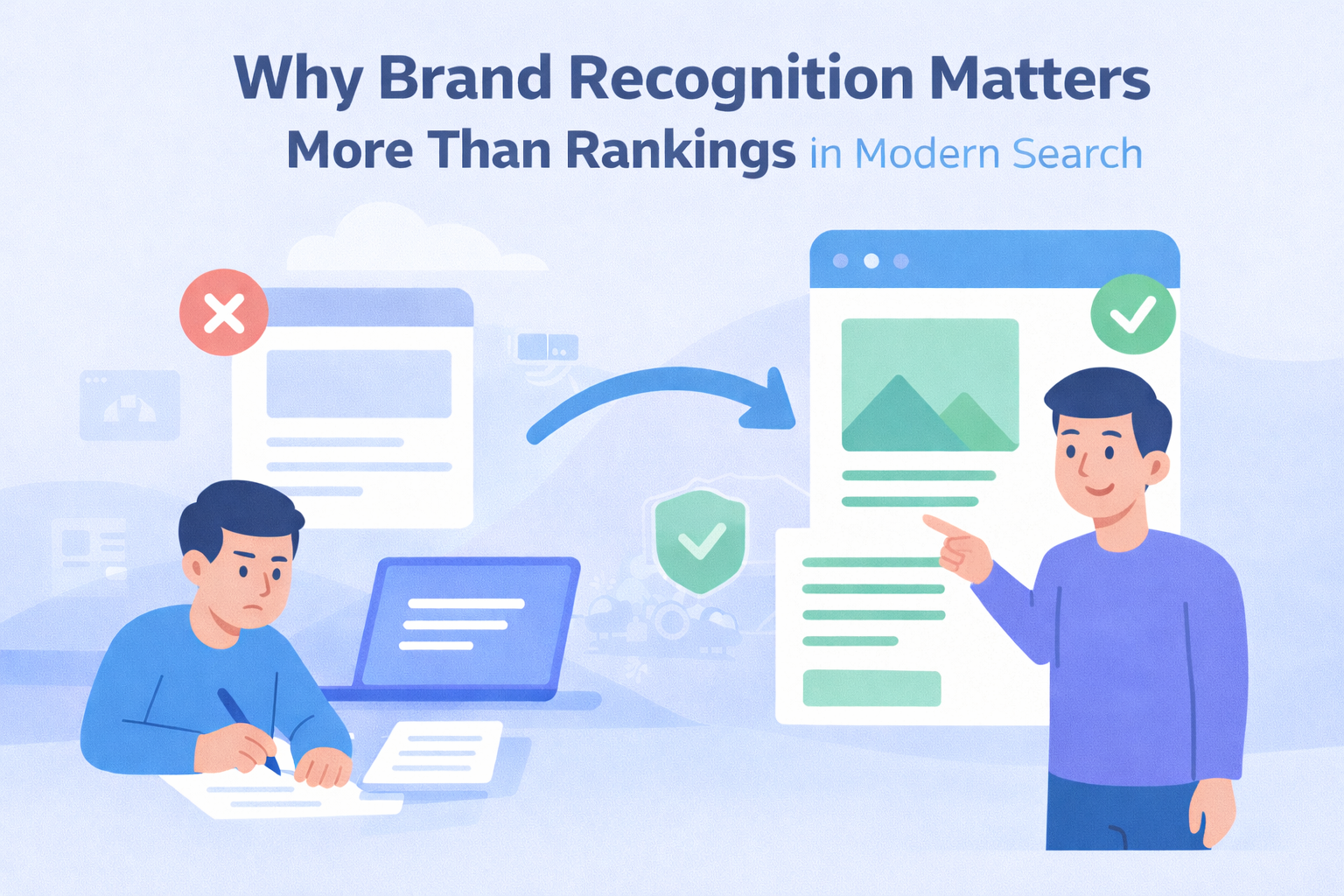
This means two websites can appear side by side, yet receive vastly different levels of engagement simply because one brand feels known.
Ranking still determines visibility, but recognition determines selection.
Trust Is Pre-Loaded Before the Click
When users recognise a brand in search results, they arrive with a level of trust already established. They’re more likely to click, spend time on the site, and convert.
Unknown brands, even when ranked highly, must earn that trust from scratch. In a fast-moving search experience, many users don’t wait around to do that evaluation. They choose what feels safe.
Google sees this behaviour clearly. Higher click-through rates, stronger engagement, and repeat searches for the same brand all send powerful signals. Over time, this reinforces visibility for recognised brands and quietly weakens those without identity or recall.
In modern search, trust is not built on the page it begins before the click happens.
AI Search Favouring Recognisable Entities
As AI-powered features become more prominent, brand recognition matters even more.
AI systems aim to reduce uncertainty for users. When generating summaries or answers, they lean towards sources that appear consistent, credible, and widely referenced. Recognisable brands even smaller ones within a niche benefit from this because they behave like stable entities rather than anonymous pages.
This doesn’t mean Google only favours big brands. It favours clear brands.
A business with a defined voice, consistent messaging, and a recognisable footprint across the web is easier for AI systems to understand and reference than a collection of disconnected blog posts.
In other words, brands are easier to summarise than websites.
Rankings Without Recognition Create Fragile Traffic
One of the hidden problems with ranking-focused strategies is how unstable they are.
If your traffic depends entirely on position, a small algorithm change can undo months of progress. But when users actively seek out your brand by name, by reputation, or by familiarity visibility becomes more resilient.
Branded searches, direct visits, and repeat engagement tell Google that users value your presence, not just your keywords. That creates a feedback loop where visibility is earned through demand, not just optimisation.
This is why some brands continue to attract traffic even when rankings fluctuate. Their presence extends beyond the results page.
Brand Recognition Shapes Click Behaviour
It’s common to assume users click the top result. In reality, many users scroll past the first few listings if they don’t recognise any names.
They pause when something feels familiar. That familiarity might come from previous searches, content they’ve seen shared elsewhere, or simply consistent exposure over time.
From Google’s perspective, this behaviour matters. When a lower-ranked but recognised brand consistently earns clicks, it challenges the assumption that ranking alone defines relevance.
Over time, recognition influences performance, not the other way around.
Content Alone Is No Longer Enough
Publishing good content remains important, but content without identity blends into the background.
Modern search rewards clarity. Who is this for? Who is behind it? Why should this source be trusted over others?
Brands that answer those questions consistently through tone, positioning, expertise, and presence create recognition that extends across multiple searches and touchpoints.
Without that, even excellent content risks being treated as interchangeable.
What This Means for Businesses
The goal of search visibility is no longer just to appear it’s to be chosen.
That requires thinking beyond keywords and towards brand-building within search itself. Every page, every result, and every impression contributes to how your business is perceived, not just where it ranks.
When brand recognition grows, rankings matter less because users actively look for you. When recognition is absent, rankings matter more and even then, they may not be enough.
A Final Thought
Modern search is not a competition for position; it’s a competition for confidence.
Google can show many results, but users will choose the names they trust. The businesses that succeed are those that understand this shift and invest accordingly not by abandoning SEO, but by evolving it.
In a world where visibility is fragmented and attention is scarce, being remembered is more powerful than being ranked.