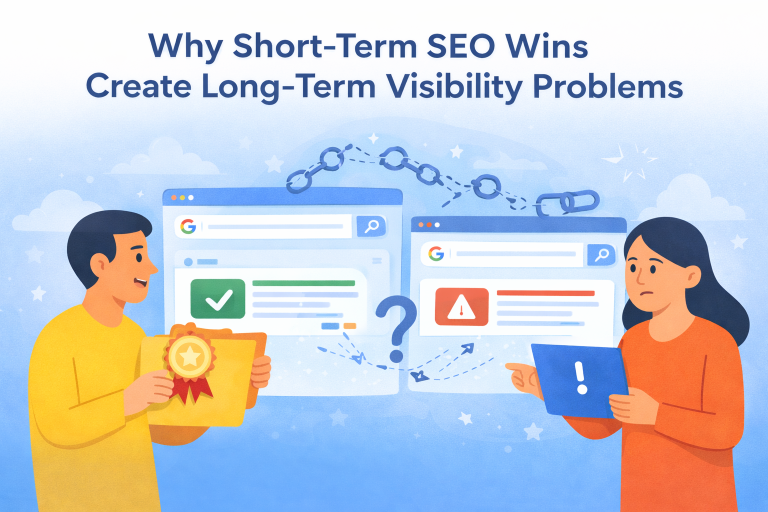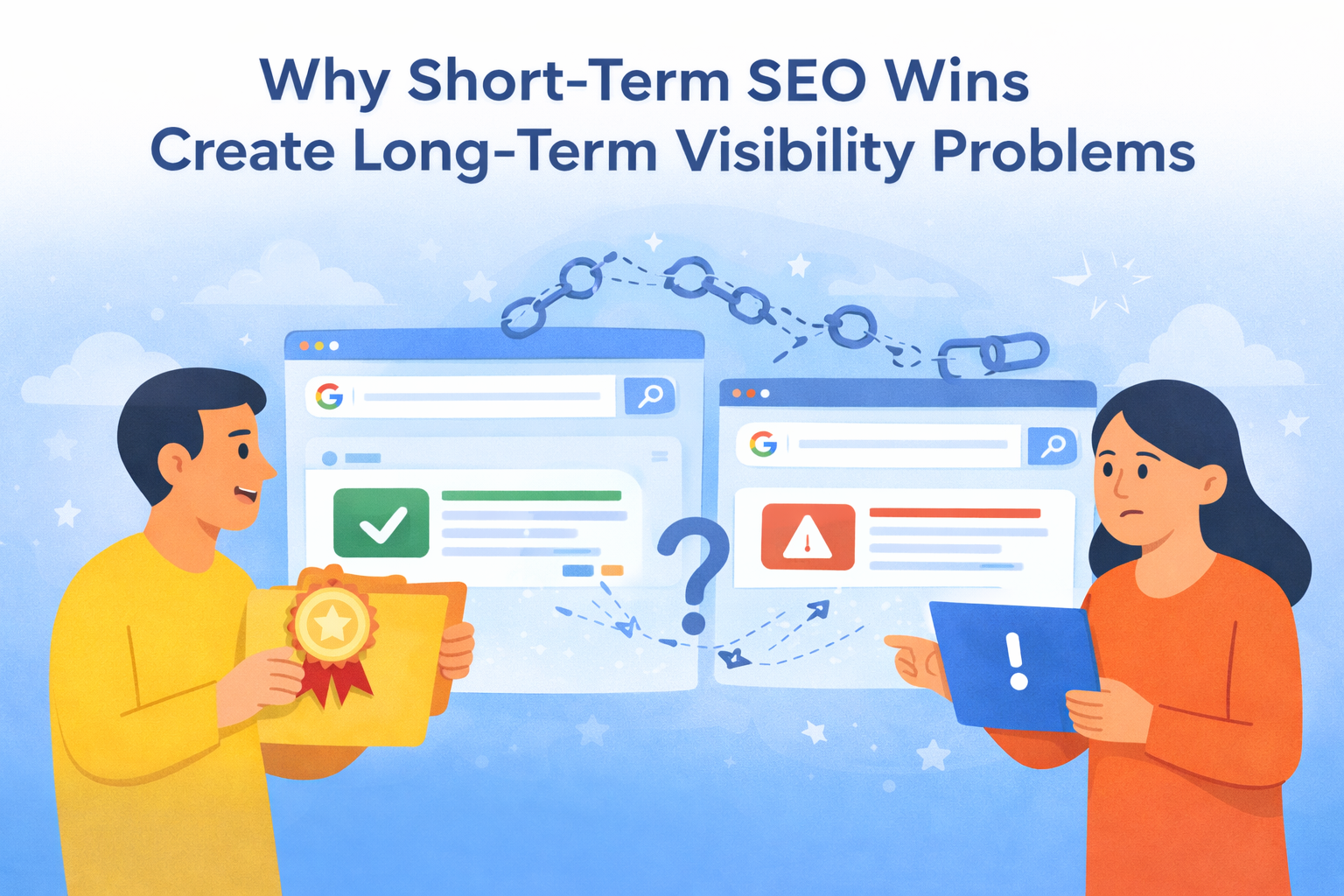
Short-term SEO wins can feel incredibly satisfying.
A quick ranking jump.
A sudden traffic spike.
A report that finally looks “green”.
For many businesses, these moments are treated as proof that the strategy is working. Yet months later, those same sites often experience declining visibility, unstable traffic, or a complete loss of momentum — sometimes without any obvious trigger.
This isn’t bad luck. It’s a structural issue.
In modern search, short-term SEO wins often come at the expense of long-term visibility.
The Appeal of Fast Results
Search is competitive, and pressure to deliver results quickly is real. Whether it’s to satisfy stakeholders, justify spend, or respond to a drop in performance, short-term tactics can seem like the fastest route forward.
These tactics usually focus on:
- chasing trending keywords,
- publishing content at speed,
- aggressively optimising pages for narrow queries,
- or reacting quickly to perceived algorithm preferences.
In isolation, these actions can work. They align temporarily with what the algorithm appears to reward.
The problem is what happens next.
When Optimisation Outpaces Understanding
Short-term wins are often built on surface-level alignment rather than deep understanding.
A page ranks because it matches a pattern the algorithm currently favours — not because it strengthens the overall clarity, authority, or structure of the website. As soon as that pattern shifts, the page loses its advantage.
Over time, a site built this way becomes fragile. Visibility depends on staying in sync with constantly moving signals, rather than on a stable foundation.
The faster the wins, the weaker the roots usually are.
Accumulated Decisions Create Structural Debt
Each quick fix leaves a trace.
Thin pages added to chase keywords.
Overlapping content targeting similar intent.
Inconsistent internal linking.
Pages created without a clear long-term role.
Individually, these decisions seem harmless. Collectively, they create structural debt — a site that is harder for search engines to understand and harder for users to navigate.
Eventually, visibility problems emerge not because of one bad decision, but because of years of small, reactive ones.
Short-Term Traffic Often Masks Long-Term Decline
One of the most misleading aspects of short-term SEO wins is how they mask deeper issues.
Traffic spikes create confidence. Rankings provide reassurance. But underneath, key signals may already be weakening — engagement quality, topical coherence, brand recognition, or trust.
When traffic eventually drops, it feels sudden. In reality, the decline started long before, hidden behind temporary gains.
Search doesn’t punish instantly. It reassesses gradually.
Algorithm Updates Expose Weak Foundations
When algorithm updates roll out, they don’t usually target specific tactics. They adjust how relevance, usefulness, and trust are evaluated.
Websites built on short-term wins are often the most affected, not because they violated rules, but because their visibility relied on fragile alignment rather than enduring value.
Strong foundations absorb updates. Weak ones amplify them.
This is why some sites remain stable through major changes while others fluctuate wildly.
Visibility Is Now a Site-Wide Outcome
Modern search systems evaluate websites holistically.
They look at how content connects, how expertise is demonstrated over time, and how consistently a site serves its audience. This means that isolated wins on individual pages matter less than the overall picture.
Short-term SEO tends to focus narrowly. Long-term visibility depends on cohesion.
When pages compete with each other or lack a clear role, visibility becomes harder to sustain.
The Cost of Constant Course Correction
Reactive SEO creates operational strain as well.
Teams spend time fixing drops instead of building momentum. Content is rewritten repeatedly instead of improved strategically. Confidence in search as a growth channel slowly erodes.
Ironically, chasing fast wins often leads to slower progress overall.
Reframing What “Success” Looks Like
Long-term visibility is rarely dramatic. It doesn’t spike overnight. It grows steadily, often quietly, supported by clear structure, depth of coverage, and consistent intent alignment.
This kind of success is harder to sell internally because it doesn’t promise instant results. But it compounds — and it lasts.
In modern search, durability beats speed.
A Final Thought
Short-term SEO wins aren’t inherently wrong. The problem arises when they become the strategy rather than a by-product.
Visibility problems don’t usually come from doing too little SEO. They come from doing too much of the wrong kind, too quickly.
The businesses that succeed are those willing to trade quick gratification for lasting presence — and build search visibility that holds up long after the initial win fades.
Work With Leadtap, search engine optimisation agency
If your SEO performance feels unstable despite regular wins, the issue may be structural rather than tactical. Leadtap is a search engine optimisation agency that helps businesses move beyond short-term optimisation and build search visibility designed to last — with clearer structure, stronger intent alignment, and strategies that support long-term growth. If you want SEO that compounds rather than collapses, the Leadtap team is here to help.