Not long ago, customer journey mapping was a workshop exercise. Teams gathered around a whiteboard, drew swimlanes for “awareness”, “consideration” and “decision,” and filled them with assumptions about what customers were thinking and feeling at each stage. The output was a colourful diagram that looked rigorous but was largely built on guesswork.
In 2026, that approach is obsolete. AI solutions have made it possible to map customer journeys with real behavioural data – not assumptions. Businesses that embrace this shift are gaining a decisive advantage: they know where customers drop off, which touchpoints drive conversions and how to personalise the journey in real time. Those that do not are still guessing.
This guide explains what customer journey mapping actually involves, how AI solutions are transforming it and how growing businesses can use these capabilities to reduce friction, improve conversions and build lasting customer relationships.
What Customer Journey Mapping Really Involves
A customer journey map is a visual or analytical representation of every interaction a customer has with your business – from the moment they first become aware of you to the point of purchase and beyond. A comprehensive map covers multiple dimensions: the stages of the journey, the touchpoints at each stage, the customer’s emotional state and the actions your business needs to take to move them forward.
Traditional journey mapping is valuable as a strategic exercise, but it has a fundamental limitation: it is based on what businesses think customers experience, not what they actually experience. Without real behavioural data, the map reflects internal assumptions rather than customer reality.
AI solutions address this gap directly. By analysing data from your website, CRM, email platform, social media, advertising and customer support systems, AI can reconstruct the actual paths customers take – not the paths you assumed they would take. The result is a journey map grounded in evidence, not intuition.
How AI Solutions Analyse Behaviour to Map the Journey
The core capability of AI in customer journey mapping is pattern recognition at scale. A human analyst might review hundreds of customer interactions to identify trends. An AI system can analyse millions of data points across thousands of customer interactions simultaneously, identifying patterns that would be invisible to manual analysis.
Here is how AI solutions work at each stage of the journey:
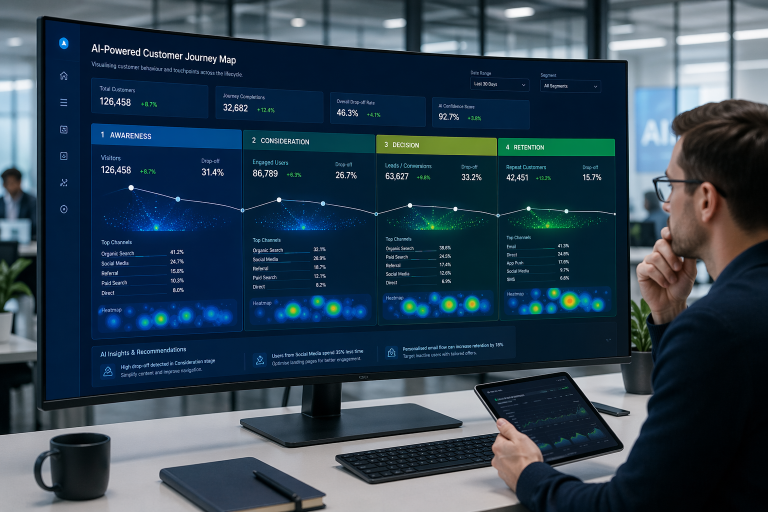
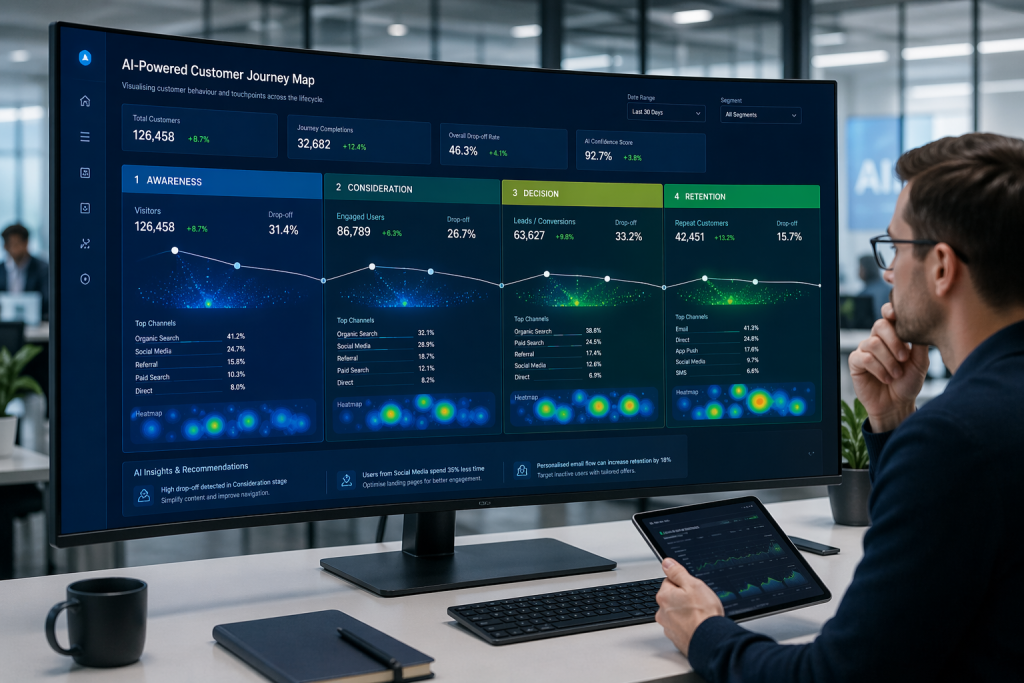
Awareness stage: At the top of the funnel, AI tools analyse which channels are driving initial discovery – organic search, paid advertising, social media, referral, direct – and which content or creative formats are generating first contact. AI can also identify the search queries that bring customers to your site for the first time, revealing the language customers use when they first encounter a problem your business solves.
Consideration stage: This is where most businesses lose potential customers without knowing it. AI solutions analyse session recordings, heatmaps, scroll depth and page flow data to identify exactly where interest fades. They detect patterns such as: customers who visit the pricing page and then leave without enquiring; users who read three blog posts but never reach a product page; visitors who add items to a cart and abandon it at a specific step. Each of these patterns represents a fixable friction point.
Decision stage: AI analyses the behavioural signals that predict conversion – and those that predict abandonment. Which combination of touchpoints leads to a purchase? How many interactions does a typical customer have before making contact? Which pages, messages or offers appear most frequently in the journeys of converted customers? This intelligence allows businesses to invest more in what works and remove what does not.
Retention stage: Post-purchase, AI monitors engagement signals to identify customers at risk of churning before they disappear. Declining email open rates, reduced login frequency or a drop in purchase cadence can all trigger proactive retention interventions – personalised offers, check-in messages or loyalty incentives delivered at precisely the right moment.
Specific AI Tools and Approaches for Growing Businesses
Growing businesses do not need enterprise-grade AI platforms to benefit from journey mapping intelligence. Several accessible tools deliver genuine capability:
Behavioural analytics platforms such as Hotjar, Microsoft Clarity and FullStory use AI to surface session insights automatically, flagging pages with high rage-click rates, unusual drop-off or confusing navigation patterns. These tools make it easy to identify the moments where customer frustration peaks.
CRM-integrated AI in platforms such as HubSpot use machine learning to score leads, predict deal likelihood and flag customers who are disengaging. This enables sales and customer success teams to prioritise the right conversations at the right time.
Predictive analytics tools analyse historical conversion data to model which customer segments are most likely to convert, which channels deliver the highest lifetime value and which journey paths lead to repeat purchase. These insights allow businesses to allocate marketing budget more effectively.
Conversational AI and chatbot data reveal, at scale, the questions customers ask when they are stuck, confused,or about to abandon. This is among the richest sources of journey intelligence available – customers will tell an AI chatbot exactly what they need to know in order to proceed.
Acting on AI-Derived Insights to Reduce Drop-Off
Information is only valuable when it leads to practical results. The practical value of AI journey mapping lies in the specific interventions it enables:
If AI analysis reveals that 40% of visitors who reach your pricing page leave without converting, the insight points to a specific problem – perhaps pricing is unclear, comparisons are missing or social proof is absent at a critical decision moment. The fix is targeted: redesign that page with the identified friction in mind.
If AI detects that customers who engage with a specific piece of content are three times more likely to convert, the response is clear: produce more content on that topic and ensure it is prominently placed in the discovery journey.
If post-purchase data shows that customers who receive a personalised onboarding email sequence within 24 hours of purchase have significantly higher retention rates, automation can deliver that sequence at scale, turning an insight into a durable revenue outcome.
How Leadtap Implements AI Solutions for a Data-Driven Edge
At Leadtap, AI solutions are not an add-on – they are integrated into the core of how the agency understands and optimises client marketing programmes. The team uses AI-driven journey analysis to identify where marketing investment is working, where it is being lost, and where the highest-value opportunities lie.
For each client, Leadtap builds a data architecture that connects the relevant systems – website analytics, CRM, ad platforms, email and social – into a coherent view of the customer journey. From this unified data picture, the agency identifies the specific friction points and growth opportunities that manual analysis would miss.
The result is a marketing programme that evolves with real customer behaviour rather than static assumptions. Campaigns are adjusted based on what the data shows. Content is created for the stages of the journey where gaps exist. Conversion rate optimisation is targeted at the specific moments where customers are most likely to be lost.
In 2026, the businesses that grow fastest are those that know their customers best – not through intuition, but through intelligence. Leadtap’s AI solutions give growing businesses the data-driven edge they need to compete with confidence. Visit [www.leadtap.ai](https://www.leadtap.ai/) to find out more.